Sault Ste. Marie has spent generations building an economy around industry and our location at the heart of the Great Lakes. Today, we have an opportunity to turn that location into another major economic advantage by establishing a modern commercial port connecting Northern Ontario businesses with customers across Canada and around the world.
Work on this project began in 2023, well before the current trade uncertainty facing Canada. The goal was to determine whether Sault Ste. Marie could develop a commercially viable public-access port that would diversify our economy, create jobs and give Northern Ontario industries a more competitive way to move their products to market. Since then, the project has moved from an idea to a developed business case backed by technical analysis, an experienced port operator and growing private-sector interest. The City began the work required to understand the commercial and technical potential of a port, ultimately securing federal support for detailed studies into market demand, port design, dredging requirements, infrastructure and commercial viability.
Technical and commercial studies have now been completed. They have strengthened the business case, identified potential markets and provided greater clarity about the infrastructure required to make the Port commercially successful. That work has also identified an opportunity to shift thousands of long-distance truck movements onto marine and rail transportation, reducing pressure on Northern highways while giving businesses another way to move goods to market.
One of the most important developments came when the City partnered with HOPA Ports, Ontario’s largest port operator and an organization with extensive experience developing and operating industrial ports throughout the Great Lakes. In September 2025, the City and HOPA formally announced their partnership to develop the Port of Sault Ste. Marie and a new north-south trade corridor. HOPA brings something essential to the project: an experienced commercial port operator with existing customers, industry relationships and connections to markets throughout Ontario and beyond.
That partnership is a key difference between earlier discussions about a Sault port and the opportunity we have today. We are no longer simply asking whether a port could work. We have an established port operator working with us to determine how to build it, attract customers and connect Sault Ste. Marie to an existing Great Lakes transportation network.
Northern Ontario produces enormous quantities of forestry products, minerals, critical minerals, steel and other goods that need to reach manufacturers and customers in Southern Ontario and beyond. Much of that freight currently travels long distances by truck. The Port would give those businesses another option: move products to Sault Ste. Marie and then use marine and rail transportation for the long-distance portion of the journey. That can mean lower transportation costs, fewer trucks travelling Highway 17 and better access to markets.
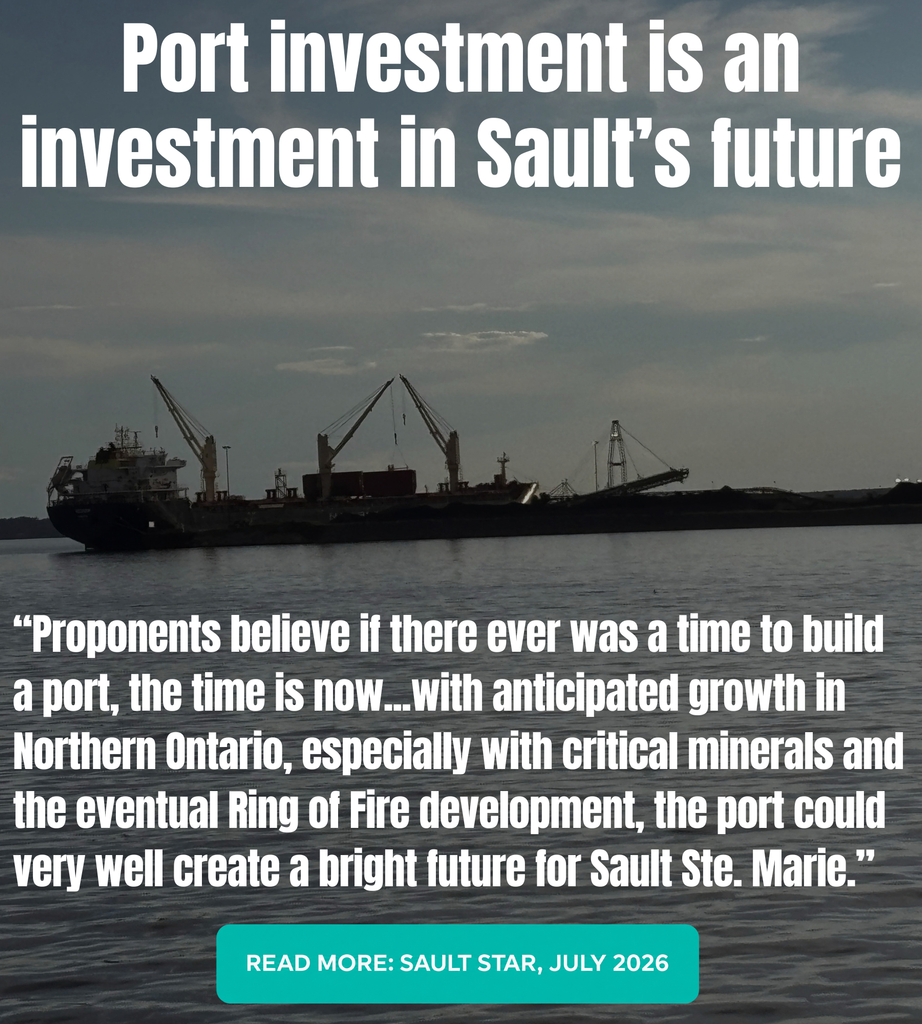
Private-sector discussions in forestry, mining, advanced manufacturing, agri-food and other industries are already helping shape the Port’s infrastructure and commercial plans. The Port of Sault Ste. Marie directly responds to that challenge. It would connect Northern Ontario’s resource economy with industrial centres in Southern Ontario and Quebec while creating another pathway to international markets through the Great Lakes–St. Lawrence Seaway. It aligns with federal efforts to strengthen internal trade and build nationally significant infrastructure, as well as Ontario’s focus on critical minerals and Northern economic development.
Put simply, it would help Canadian businesses move Canadian products through Canadian infrastructure to Canadian customers, while giving those businesses better access to markets beyond Canada. The current first phase represents one of the largest economic-development opportunities Sault Ste. Marie has pursued in years. Beyond the immediate construction activity, the project could support thousands of direct and indirect jobs, generate hundreds of millions of dollars in annual economic activity and establish an entirely new piece of economic infrastructure in Sault Ste. Marie.
That infrastructure could help existing businesses grow, attract new investment and create jobs that are not dependent on any single employer or industry. A great deal of work has been completed since this project began in 2023.
We have completed the initial technical and commercial studies, developed the business case, secured an experienced operating partner in HOPA, engaged with private-sector customers and committed municipal funding toward making the Port a reality. The next step is securing the federal and provincial investment required to build it. I have been taking that case directly to both governments because the Port is no longer simply a local infrastructure proposal. At a time when Canada and Ontario are looking for projects that strengthen domestic trade, support Canadian industry and make our economy more resilient, the Port of Sault Ste. Marie is ready to help accomplish those goals.
I am focused on turning the opportunity provided by the current moment into a working Port of Sault Ste. Marie.
(Minister) MacKinnon said the project ‘captures exactly the spirit of the moment we’re in in Canada’
“We need visionary leaders to come up with these projects that help build our country,” Canada’s Transportation Minister Steve MacKinnon said.